Source Frosted Microscope Cover Slips for Lab Use
Find 30 frosted microscope cover slips from Chinese factories. Compare sizes like 22x22mm and thicknesses from 0.13mm to 2.0mm. Options include ISO and CE certified glass slides for laboratory and medical applications; compare the available evidence and request quotations based on your requirements.
Key considerations
Products List




Comprehensive Sourcing Guide
Frosted Microscope Cover Slips Sourcing Guide
Procurement teams must first distinguish between standard transparent glass and frosted variants, as the latter offers a critical functional advantage for sample identification. The observed market data indicates that frosted ends are a specific feature available on certain glass cover slips, allowing researchers to write directly on the slide without obscuring the specimen area. This customization is essential for laboratories managing high volumes of cell culture slides or microscope slides where sample tracking is paramount. Buyers should verify that the "frosted" attribute applies to the specific model number they intend to purchase, as not all listed products in the catalog carry this feature.
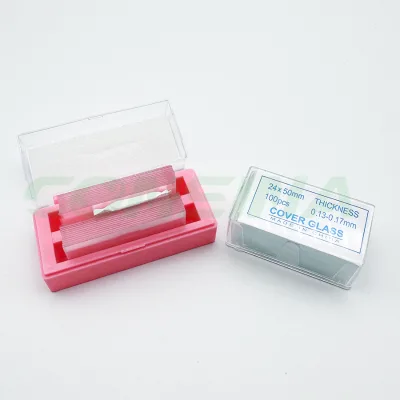
When evaluating product listings, it is vital to confirm the physical dimensions and thickness specifications that align with your microscope objectives. The available data shows a wide range of sizes, including 18x18mm, 22x22mm, and 24x50mm, with thicknesses varying from 0.13mm to 2.0mm depending on the application. A mismatch in thickness can lead to focus errors or cover glass breakage during high-magnification imaging. Therefore, buyers must cross-reference the specific model number, such as JLY-ZBP-001 or Hw-Cg01, against their laboratory's equipment requirements to ensure the selected glass cover slips provide the necessary optical clarity and mechanical stability.
Product Scope and Observed Listing Signals
The current market landscape for glass cover slips reveals a diverse inventory ranging from single-unit samples to bulk industrial packaging. Listings indicate that products are often supplied in boxes containing 50 pieces, with larger orders potentially arriving in corrugated cartons containing up to 500 boxes. This variability in packing formats suggests that suppliers cater to both small research labs requiring immediate, small-batch needs and large medical facilities demanding high-volume stockpiles. Buyers should carefully inspect the "Product Name" and "Packing" fields to ensure the unit count matches their inventory planning and storage capabilities.
Customization capabilities are a significant signal of supplier flexibility in this sector, with many manufacturers offering logo printing and specific shape modifications. The data confirms that customization is available for color, logo, and potentially shape, allowing institutions to brand their supplies or adapt to unique experimental setups. However, the "Color" attribute is listed as both "Customized" and "Transparent," requiring clarification on whether the frosted area is the only variable or if the entire glass can be tinted. Procurement officers must explicitly request samples to verify that the customization process does not compromise the optical properties or the structural integrity of the glass cover.
Technical Specifications to Verify
Thickness consistency is the most critical technical parameter for microscope cover slips, as deviations can severely impact image resolution and depth of field. The observed specifications include precise measurements such as 0.8mm, 1.2mm, 1.5mm, and 2.0mm, alongside thinner options ranging from 0.13mm to 0.17mm. These variations correspond to different magnification levels and immersion oil requirements. Buyers must verify the exact thickness tolerance for their specific application, as a standard 1.0-1.2mm range may be unsuitable for high-resolution oil immersion microscopy, necessitating a switch to the thinner 0.13-0.17mm variants.
Edge finishing and surface treatment are equally important for handling safety and sample preparation efficiency. The product data highlights features such as "Ground Edge" and "Frosted End," which serve distinct purposes in the laboratory workflow. Ground edges reduce the risk of cuts during manual handling, while the frosted end provides a designated area for labeling. It is essential to confirm that the "Form" is listed as "Polish/Frosted" to ensure the glass is free from scratches that could interfere with light transmission. Additionally, the "Cleaning" attribute suggests the need for pre-use verification, as some products may require specific cleaning protocols before being used for sensitive cell culture applications.
Compliance and Safety Documentation
Regulatory compliance is a non-negotiable aspect of sourcing laboratory glassware, particularly for applications in medical and clinical settings. The observed listings mention certifications such as ISO, CE, FSC, and GMP, which indicate adherence to international quality and safety management systems. However, the presence of these certifications in a general listing does not guarantee that every specific batch of glass cover slips meets these standards. Buyers must request current, batch-specific certificates of analysis and compliance documentation to verify that the products meet the rigorous requirements of their local regulatory bodies and institutional safety protocols.
Sterilization status is another critical safety factor that directly impacts the suitability of the product for cell culture and medical applications. The data explicitly notes that some products are "Without Ethylene Oxide Sterilization," which is a significant constraint for sterile procedures. Laboratories requiring sterile cover slips must identify suppliers who offer ethylene oxide sterilization or alternative sterilization methods. Procurement teams should not assume sterility based on the general product category; instead, they must explicitly confirm the sterilization method and shelf life, which is listed as ranging from 2 to 5 years, to ensure the product remains viable for its intended use.
Cost Drivers and Commercial Terms
Pricing in the microscope cover slip market is highly sensitive to order volume, with observed minimum order quantities (MOQ) ranging from a single unit to 100,000 units. This wide disparity suggests that unit costs will vary significantly based on the scale of the purchase, with bulk orders likely benefiting from economies of scale. Buyers should analyze their consumption rates to determine the optimal order size that balances inventory holding costs with the per-unit price reduction. It is also important to note that customization options, such as logo printing or specific dimensions, may incur additional charges that are not reflected in the base price range of 0.01 to 2.32 USD.
Lead times and delivery schedules are major commercial variables that can disrupt laboratory operations if not managed proactively. The observed delivery dates range from 7 to 30 days, depending on the supplier and the specific product model. For urgent needs, buyers should prioritize suppliers with shorter lead times, such as the 7-10 day window, while planning for longer timelines for customized or high-volume orders. Additionally, the "Quality Guarantee Period" of one year and the "Shelf life" of 2-5 years should be factored into the total cost of ownership, ensuring that the purchased inventory remains usable throughout its intended lifespan without degradation.
Supplier Qualification and Quality Control
Supplier identity and manufacturing capability are foundational to ensuring consistent product quality and supply chain reliability. The data confirms that the suppliers are factories located in Shanghai, China, and offer OEM services, indicating direct manufacturing control rather than third-party trading. This direct factory relationship often allows for better quality control and more responsive communication regarding technical specifications. Buyers should verify the "Company Type" and "Factory" status to ensure they are dealing with the actual manufacturer, which can facilitate more effective resolution of quality issues and customization requests.
Quality control processes must be rigorously evaluated to prevent the receipt of defective glass cover slips that could compromise experimental results. The "Quality Guarantee Period" of one year and the "Feature" of ground edges suggest a focus on durability and safety, but these claims require validation through independent testing or third-party audits. Procurement teams should request quality control reports that detail inspection methods for thickness uniformity, edge smoothness, and surface clarity. Furthermore, the availability of free samples allows buyers to conduct their own preliminary tests before committing to large orders, ensuring that the product meets the specific performance standards of their laboratory.
Long-Term Procurement Checks
Sustaining a reliable supply of frosted microscope cover slips requires ongoing monitoring of supplier performance and product consistency over time. Buyers should establish a schedule for periodic re-verification of certifications, such as ISO and GMP, to ensure that the supplier maintains their compliance status throughout the contract period. Regular audits of the manufacturing process can help identify potential deviations in quality that might arise from changes in raw materials or production techniques. This proactive approach minimizes the risk of supply disruptions and ensures that the laboratory continues to receive glass cover slips that meet their exacting standards.
Inventory management strategies should also account for the shelf life and storage conditions of the glass cover slips to prevent waste and degradation. With a shelf life of 2 to 5 years, buyers can plan for long-term stockpiling, but they must ensure that storage environments remain stable to preserve the integrity of the glass. It is advisable to implement a first-in, first-out (FIFO) system to utilize older stock before it expires. Additionally, maintaining open communication channels with the supplier regarding production updates and potential supply chain risks will help procurement teams adapt to market changes and maintain a steady flow of essential laboratory supplies.
FAQs
What are the standard thickness options for frosted microscope cover slips?
Standard thickness options include 0.8mm, 1.2mm, 1.5mm, and 2.0mm for general laboratory use. Some specific models offer a range of 1.0mm to 1.2mm or 0.13mm to 0.17mm depending on the manufacturer. These variations allow users to select the appropriate thickness for specific microscopy applications and sample requirements.
Can I request custom logo printing on these glass cover slips?
Yes, custom logo printing is available for these glass cover slips. Manufacturers accept customization requests and can apply logos directly to the product. This service allows laboratories and medical facilities to brand their supplies while maintaining the high quality and transparency required for professional microscope slide applications.
Which certifications do these microscope cover slips typically hold?
These products typically hold ISO, CE, FSC, and GMP certifications. These standards ensure the glass covers meet international quality and safety requirements for laboratory and medical applications. Buyers can verify these credentials to confirm the supplier adheres to strict manufacturing protocols and regulatory compliance for medical device components.
How long is the delivery time for bulk orders of cover slips?
Delivery times generally range from 7 to 30 days depending on the order volume and specific supplier. Some manufacturers offer a lead time of about 15 to 30 days, while others can deliver within 7 to 10 days for smaller quantities. Buyers should confirm the exact schedule based on their specific order size and packaging needs.
What are the available size specifications for frosted microscope cover slips?
Available sizes include 18x18mm, 22x22mm, 24x24mm, 24x32mm, 24x50mm, and 24x60mm. Larger options like 25.4x76.2mm or 26x76mm are also listed for specific slide formats. These dimensions ensure compatibility with various microscope stages and standard laboratory slide preparations for cell culture and medical testing.
What is the minimum order quantity for purchasing these glass covers?
Minimum order quantities vary significantly, ranging from 1 unit up to 100,000 units depending on the supplier. Some vendors require a minimum of 10,000 boxes, while others accept much smaller trial orders. Buyers should check specific supplier terms to find a quantity that matches their inventory needs and budget constraints.
Are these microscope slides and cover slips disposable or reusable?
These products are classified as disposable glass cover slips designed for single-use applications. They are intended for laboratory and medical settings where sterility and contamination prevention are critical. The disposable nature ensures consistent optical clarity and eliminates the need for complex cleaning procedures between different sample analyses.